#militarytechnology
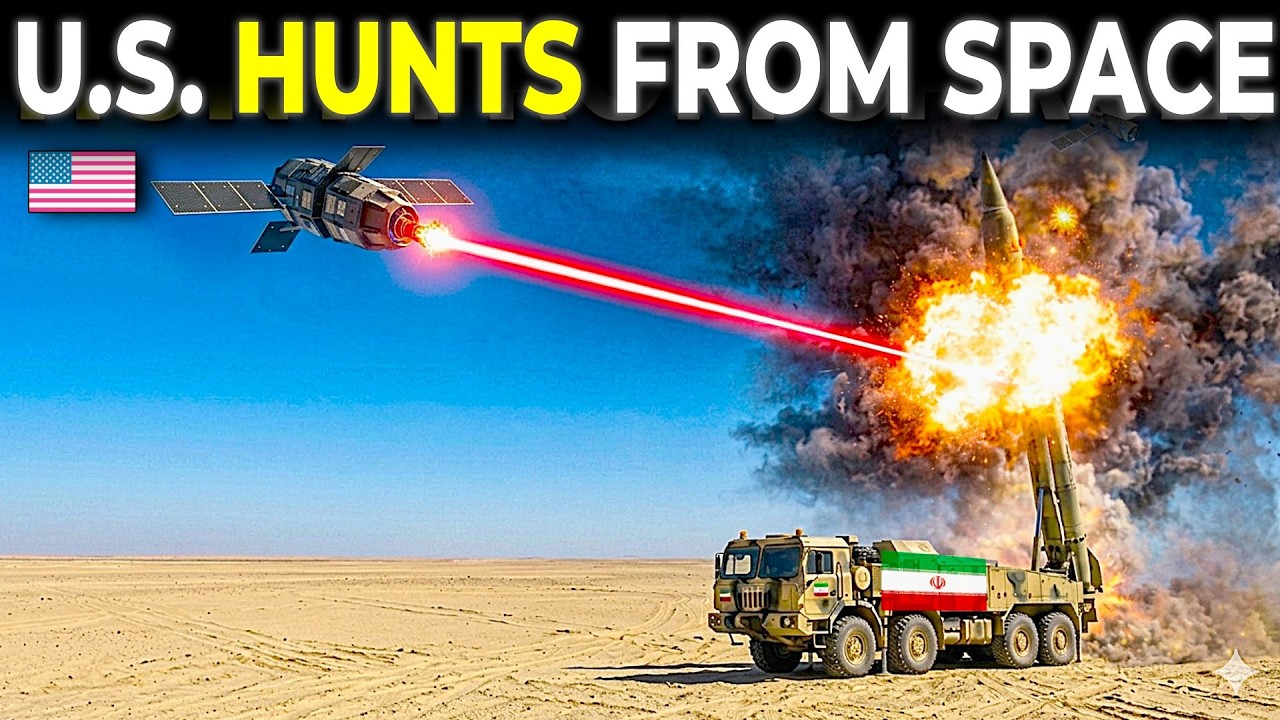
Iran fires a missile… and within minutes the launcher is already being tracked from space.
The United States has built a global surveillance network capable of detecting missile launches almost instantly using SBIRS infrared satellites, Next-Generation OPIR sensors, classified NRO spy satellites, radar imaging satellites, and Pentagon AI systems like Project Maven.
But finding a mobile missile launcher in a country the size of Iran is not easy.
So how does the United States actually track and locate these launchers?
In this video we break down the entire modern missile-hunting kill chain — from infrared detection in orbit to AI-powered targeting and precision strikes.
You will see how U.S. Space Force satellites, KH-11 reconnaissance satellites, synthetic aperture radar systems, and commercial satellite constellations work together to monitor missile activity across the Middle East.
This is the technology behind the “four-minute missile detection window” — a capability that is quietly reshaping modern warfare and missile deterrence.
In This Video
• How SBIRS satellites detect missile launches using infrared sensors
• The Next-Generation OPIR early-warning satellite system
• How KH-11 spy satellites capture ultra-high-resolution imagery
• How Synthetic Aperture Radar satellites track vehicles through clouds and darkness
• How Project Maven AI identifies missile launchers automatically
• The role of commercial satellite constellations like Maxar and Planet Labs
• How the U.S. military kill chain tracks and targets mobile missile launchers
Why This Matters
Modern ballistic missile launchers are mobile, concealed, and often hidden in tunnels or underground bases.
To counter that threat, the United States has developed a multi-layer surveillance architecture combining satellites, artificial intelligence, reconnaissance aircraft, and global sensor networks.
Understanding how this system works reveals how modern militaries detect and respond to missile launches in real time.
Subscribe for more military technology, defense analysis, megaprojects, and strategic weapons breakdowns.
#usiran #usmilitary #operationepicfury #militarytechnology
0:00 The 4-Minute Missile Window
0:37 The Missile That Slipped Through
1:08 Why Missile Defense Is Failing
01:50 Operation Epic Fury
02:18 The Satellites Watching Earth
02:27 SBIRS – The Heat Detection System
03:23 Next-Generation OPIR Sensors
03:49 Spy Satellites That See Everything
04:13 Radar Satellites That See Through Clouds
04:49 Commercial Satellite Surveillance
05:21 Project Maven AI Targeting
06:18 The Military Kill Chain
06:33 Drones and Persistent Surveillance
06:50 B-2 Bombers and Bunker Busters
07:51 Can Iran Still Hide Its Launchers?

US CENTCOM confirmed that B-2 Spirit bombers struck "hardened ballistic missile facilities" in Iran during Operation Epic Fury. But hidden at the bottom of the official briefing was a single cryptic line: "And special capabilities we can’t list here". While the world watches the explosions, we are looking at the subatomic reality. Did the US just use Muon Tomography to turn the Zagros Mountains into glass?[The Technical Deep-Dive - Designed for Information Gain & GIS]For decades, Iran’s "Missile Cities"—buried 2,000 feet under solid granite in Natanz, Fordow, and Isfahan—were considered a black box. Traditional Ground Penetrating Radar (GPR) fails at 40 feet. However, DARPA’s MuS2 program (Muons for Science and Security) uses high-energy cosmic ray particles to "X-ray" through kilometers of rock. In this video, we analyze the operational indicators that suggest this tech was just field-tested in the US-Israel-Iran conflict: The "Void Map": How B-2s knew exactly where to aim the 30,000lb GBU-57 MOP bombs. The RQ-180 Connection: The role of stealth high-altitude reconnaissance in collecting muon scattering data. Iranian Countermeasures: Why satellite imagery from February 2026 showed IRGC engineers frantically backfilling tunnel entrances at Isfahan. The Archaeology Blueprint: How Israeli researchers at Tel Aviv University proved this tech works in Jerusalem before weaponizing it for the Zagros Mountains.Is the era of underground warfare over? If the US can see through a mountain, there is no such thing as a "Secret Base."
If you want to stay ahead of the technical curve on the US-Iran-Israel war, subscribe for deep-dives into the black projects the media ignores.
#usiran #militarytechnology #usairforce #usmilitary
0:00 The "Special Capability" in Operation Epic Fury
01:45 Iran’s Missile Cities: The Underground Stalemate
03:12 DARPA MuS2: What is Muon Tomography?
04:40 Why GPR Fails and Muons Succeed
06:15 The GBU-57 MOP: Why you need a "Void Map"
08:02 Israel’s Secret Blueprint: From Archaeology to War
09:15 The RQ-180 "Great White Bat" & Laser Plasma Acceleration
10:00 The End of the Underground Fortress

Russia’s Reported $20M Bounty on Magyar Brovdi: Why Ukraine’s Delta Network Matters
Delta Battlefield System: Why Russia Reportedly Put $20M on Magyar Brovdi
Magyar Birds and Delta: Ukraine’s Drone Ecosystem Challenges Russia’s Winter Strategy
Ukraine’s Unmanned Systems Forces: The Leadership Lesson Behind Russia’s Reported Bounty
Can Patriot Interceptors and Delta Help Ukraine Withstand Russia’s Winter Pressure?
I examine reports that Russia has offered a $20 million bounty for information on Robert “Magyar” Brovdi, commander of Ukraine’s Unmanned Systems Forces, and why he has become such a high-value target. Drawing on Wall Street Journal reporting, I focus on the operational system behind Magyar Birds: Ukraine’s Delta battlefield-management network, which links drone crews, sensors, strike platforms, map-based target alerts, and post-mission data.
The larger lesson is not simply that drones matter. It is that cheap, rapidly adaptable systems can gain power when paired with decentralized decisions and fast feedback. I also assess Russia’s reported winter strategy of long-range missile and drone attacks on Ukraine’s energy infrastructure; Kyiv’s stated resilience preparations and interceptor shortfalls; Kaja Kallas’s call for European states to transfer Patriot interceptors; and the political pressures in Germany and France that Moscow may hope will erode support for Ukraine.
00:00 Reported $20 Million Bounty on Robert Brovdi
03:36 Why Russia Is Targeting Ukraine’s Drone Commander
07:04 Data, Delegation, and Rapid Drone Innovation
10:57 European Air Defense and Patriot Interceptors
14:04 Political Pressure in Germany and France
16:05 Russian Battlefield Losses and Diplomatic Calculations
#ukraine #russiaukrainewar #dronewarfare #militarytechnology #nato #airdefense
facts over noise. Context over headlines. Truth over talking points. Principle over partisanship.
Here is the direct link to the Ukraine Support Bridge: https://ukrainesupportbridge.com/
***** To support me as as I provide Ukraine war context: *****
Patreon: https://www.patreon.com/ProfessorGerdesExplains
Buy Me A Coffee: https://buymeacoffee.com/professorgerdes
Paypal: https://www.paypal.com/paypalme/professorgerdes
YouTube Channel Membership: https://www.youtube.com/@Profe....ssor-Gerdes/membersh
🇺🇸 Contact the White House to express your support for Ukraine
https://www.whitehouse.gov/contact/
*****IF YOU WISH TO PROVIDE DIRECT AID TO UKRAINE: *****
🇺🇦 I have partnered with Greg Terry for all donations to Ukraine.
Here is the direct link to the Ukraine Support Bridge: https://ukrainesupportbridge.com/
🇺🇸 Alternatively, you may choose to donate to Samaritan’s Purse:
https://www.samaritanspurse.org/our-ministry/ukraine-response/?utm_source=FY22UkraineResponseVanityURL&utm_medium=direct&utm_campaign=m_YUKR-22L3&utm_content=Ukraine-Response-Redirect%20%20
🇺🇦 If you wish to support the Ukrainian Army, give directly to United 24. Follow this link: https://u24.gov.ua/
***BUY SOMETHING TO SHOW YOUR SUPPORT FOR UKRAINE ***
🇺🇦 If you purchase from Saint Javelin with my link below, a cut of the proceeds will go directly to humanitarian aid for soldiers (bandages, tourniquets, etc.). I don't get the revenue. It goes to buy medical supplies from UnitewithUkraine.com. Use this link: https://www.saintjavelin.com/en-us?utm_source=YouTube&utm_medium=Social&utm_campaign=Gerdes
🇺🇸 This is the absolute CHEAPEST THING YOU CAN DO to support Ukraine (This is NOT MY SITE) https://amzn.to/4aPtwQr - Just support the war effort somehow.
🇺🇦 I wrote a book about Ukraine's president Zelenskyy which I have updated for the first 4-5 months of the war in Ukraine: It is free if you have Amazon Kindle Unlimited or $9.99 otherwise: https://amzn.to/3Q2wnyE
🇺🇦 If you cannot give or buy, you can like, share, and pray for the people of Ukraine.
🇺🇸 Please leave comments and tell me how I can help you gain more perspective. You can contact me @Dr_Gerdes on Twitter or email professorgerdesyt@gmail.com
#ukraine #ukrainerussiawar #ukrainewar
